

- '바카라사이트 장난감-Y01' L/O briefing session held at the Financial Investment Education Center in Yeouido, Seoul, on the afternoon of December 18
- Co-development partner 바카라사이트 장난감 licenses out '바카라사이트 장난감-Y01' technology to Sanofi in a KRW 1.5 trillion deal
- Accurate 'Tau after Amyloid' prediction validated as company targets three more global L/O deals by 2030
[by Ji, Yong Jun] Oscotec has achieved another successful open-innovation milestone by licensing its Alzheimer's disease drug candidate, ‘ADEL-Y01 (development code),’ to the multinational pharmaceutical company Sanofi. Oscotec is advancing a business model aimed at securing three additional global L/Os by 2030, building on its role as one of the original developers of lazertinib, the first Korean-developed anticancer drug to receive approval from the U.S. Food and Drug Administration (FDA).
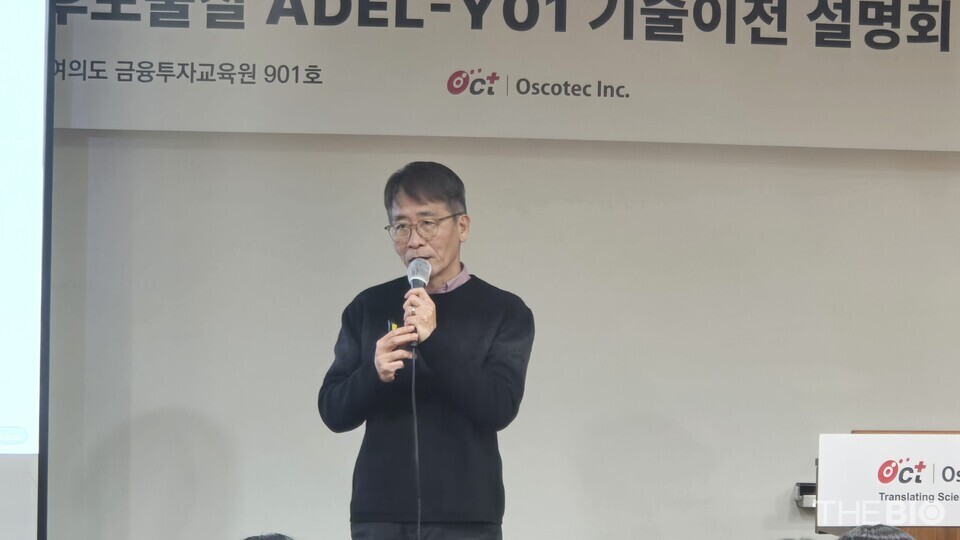
On the afternoon of December 18, Oscotec held a technology transfer briefing for its tau-targeting Alzheimer's disease candidate, ADEL-Y01, at the Korea Financial Investment Education Center in Yeouido, Seoul. The session underscored the significance of the licensing agreement for ADEL-Y01, which was valued at up to USD 1.04 billion (approximately KRW 1.5296 trillion), when it was signed by ADEL and Sanofi on December 16. The session also outlined the company’s future business strategies.
ADEL-Y01 is a monoclonal antibody that 바카라사이트 장난감 secured through a co-development agreement with ADEL in 2020. Under a clearly defined division of roles, 바카라사이트 장난감 oversaw preclinical studies (pharmacokinetics and toxicity), as well as clinical development. Meanwhile, ADEL was responsible for chemistry, manufacturing, and controls (CMC) and business development (BD).
Sanofi and ADEL executed a licensing-out agreement targeting acetylated tau protein (acK280) at the lysine-280 position. According to the agreement, the upfront payments and subsequent revenues that ADEL receives from Sanofi will be shared between ADEL and 바카라사이트 장난감 at a ratio of 53:47, as outlined in the co-development agreement that the two companies signed in 2020.
Of the USD 80 million upfront payment that ADEL received from Sanofi, Oscotec’s share is estimated at approximately KRW 55.3 billion. In addition, ADEL and Oscotec will equally share future milestone payments (53:47), related to clinical development, regulatory approval, and commercialization. They will also share royalties based on net sales, which provides further revenue potential.
"Following lazertinib, ADEL-Y01 represents the second-largest global licensing-out (L/O) achievement. ADEL-Y01 clearly demonstrates the validity of the underlying hypothesis, the robustness of the data, and its strong potential for commercial success," said Yoon Tae-young, CEO of Oscotec.
"From the outset of the co-development agreement with ADEL, ADEL was designated as the owner of the asset. To add symbolic meaning, we adopted a structure that granted greater authority to the original developer (ADEL) rather than implementing an equal 50-50 profit-sharing arrangement. The profit-sharing ratio was also adjusted slightly as Sanofi requested intellectual property (IP) rights that extended beyond the scope of the original co-development agreement between ADEL and Oscotec for ADEL-Y01," Yoon further commented.
Yoon attributed Oscotec's success in securing a large-scale global licensing agreement for ADEL-Y01, following the success of lazertinib, to what he described as the company’s ‘fundamental approach to new drug development.’ "In 2020, Alzheimer's disease drug development was largely centered on amyloid beta antibodies. However, skepticism toward the amyloid hypothesis was intensifying at the time due to successive clinical failures. As confidence in the amyloid hypothesis began to wane, the shift toward tau became inevitable, and we recognized this transition as a strategic business opportunity," he recalled.
For Oscotec, the decision to co-develop ADEL-Y01 with ADEL was challenging. Having traditionally focused on small-molecule compounds, this marked Oscotec's first foray into the antibody-based drug sector. Moreover, despite the inflow of milestone payments from lazertinib, the growing investment burden associated with advancing its internal pipeline, including denfivontinib and cevidoplenib, meant that committing additional resources to a new antibody project was, in Yoon’s words, practically a calculated gamble.
Oscotec expects ADEL-Y01 to secure a significant share of the tau antibody market, which is projected to reach KRW 45 trillion (approximately USD 30.4 billion) by 2037. "Even under conservative assumptions, the tau antibody market is expected to peak around 2037, with scenarios ranging from KRW 5 trillion, a base-case scenario of around KRW 30 trillion, and an optimistic scenario of up to KRW 45 trillion. If ADEL-Y01 is launched around 2030 as a best-in-class or first-in-class novel drug, it has the potential to capture a significant portion of this market," Yoon remarked.
This outlook is based on the successful regulatory approval of ADEL-Y01. Yoon explained that, should ADEL-Y01 be successfully commercialized, ADEL and 바카라사이트 장난감 would be eligible to receive double-digit commercial royalties based on product sales.
He characterized the ADEL-Y01 transaction as ‘a beginning rather than an end,’ outlining a vision to secure a total of three global licensing-out agreements by 2030. "Oscotec will restructure pipeline assets that do not align with its future strategy and concentrate its capabilities on two core areas: 'anticancer therapies and fibrosis,'" he emphasized.
Oscotec has designated its anticancer drug candidate OCT-598 (development code) as a next-generation core asset. "OCT-598 has already begun dosing its first patient in a Phase 1 clinical trial. Over the next two to three years, we plan to identify at least two new target programs, including follow-up projects such as renal fibrosis," Yoon explained.
"We have discontinued existing assets such as denfivontinib and cevidoplenib. Within the next six months, we plan to reorganize these legacy assets through various approaches, including licensing and partnerships supported by external funding," Yoon further added.