

- President and CEO 바카라사이트 굿모닝 Kyung-ah holds a press conference at the JP Morgan Healthcare Conference on January 14 (local time)
- Further strengthening the biosimilar business…Seven follow-up pipeline products were presented
- IND candidate approved…Plans to add at least one new candidate each year
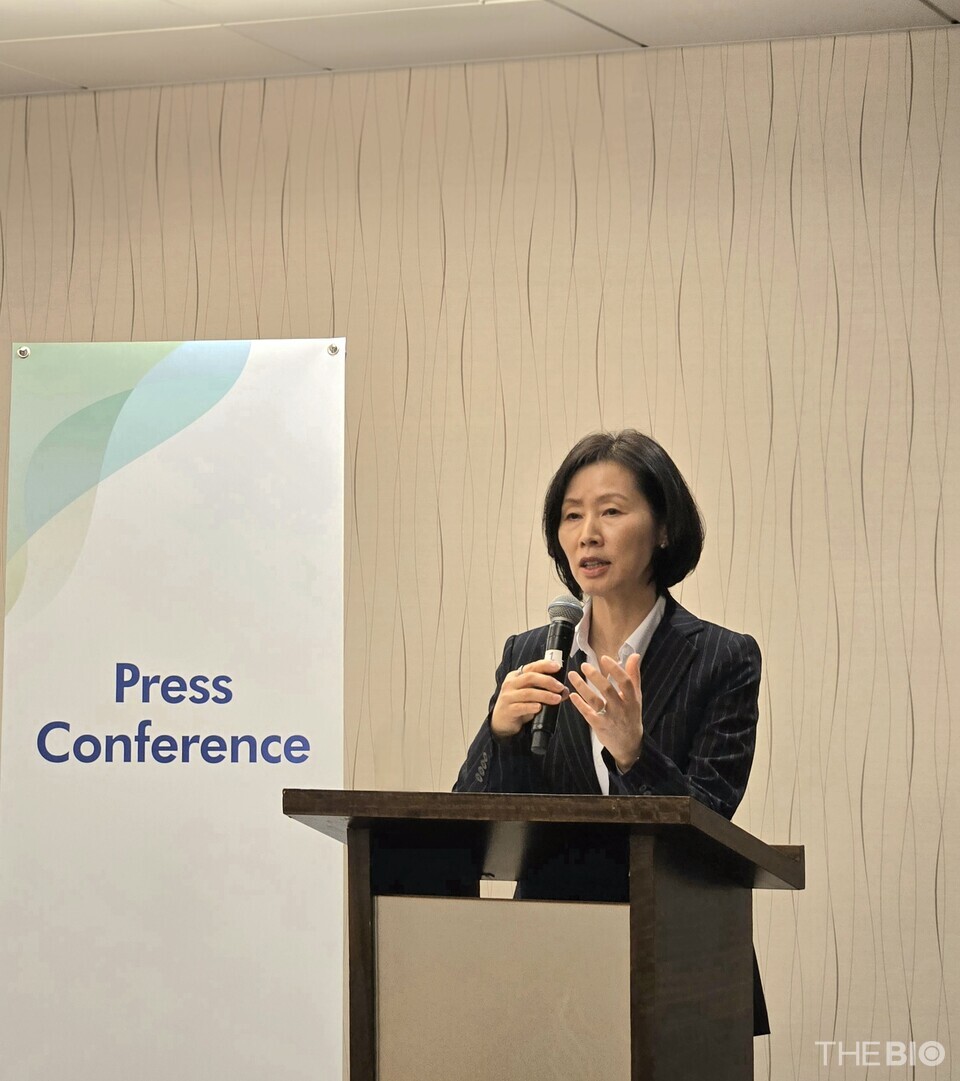
[by Ji, Yong Jun] Kim Kyung-ah, president and CEO of Samsung Bioepis, made her first official public appearance one year after assuming office, expressing her clear commitment to transforming the company into a ‘Korean Big Pharma.’ She emphasized an ambition to move beyond the company’s established success in biosimilars and to fully realize the core identity of a biotechnology company: new drug development.
Since assuming the roles of President and CEO of Samsung Bioepis in 2024, Kim has overseen the overall management of Samsung Epis Holdings, Samsung's bio holding entity, as well as its subsidiary Epis Nexlab, while assuming broad responsibility for the group’s bio-related business operations.
At a press conference held on January 14 (local time) during the JP Morgan Healthcare Conference in San Francisco, Kim stated, "Building on the world-class research, process, and clinical capabilities that Samsung Bioepis has built, we will now move forward with expansion into the novel drug business." Leveraging the company’s milestone achievement of exceeding KRW 2 trillion (approximately USD 1.3 billion) in global biosimilar sales last year, she outlined plans to aggressively broaden the portfolio while actively pursuing open innovation.
바카라사이트 굿모닝 Bioepis plans to expand its biosimilar portfolio to a total of 20 products by 2030. To date, the company has obtained regulatory approval for 11 biosimilars from the U.S. Food and Drug Administration (FDA) and the European Medicines Agency (EMA). 바카라사이트 굿모닝 Bioepis aims to develop an additional 10 biosimilars targeting global blockbuster biopharmaceuticals, including Keytruda, Dupixent, Tremfya, Taltz, Enhertu, Entyvio, and Ocrevus.
Regarding new drug development, Kim said, "We have recently obtained Investigational New Drug (IND) approval for our antibody-drug conjugate (ADC) candidate, SBE303 (development code). Beginning in 2027, we plan to advance at least one novel drug candidate into the clinical trial pipeline on an annual basis." She added, "We are also targeting the start of clinical development for an additional ADC candidate in 2027."
Epis NexLab, another subsidiary of Samsung Epis Holdings, is concentrating its efforts on the development of a long-acting peptide dosing platform. "Securing a long-term dosing cycle remains a significant unmet need for peptide hormone therapies, including glucagon-like peptide 1 (GLP-1). Given the inherent instability of peptide-based modalities, Epis NexLab is exploring technologies aimed at stabilizing peptides to enable sustained, long-term administration," Kim explained.
The following is an interview in a Q&A format with Kim Kyung-ah, President and CEO of 바카라사이트 굿모닝 Bioepis.
Q. What is Samsung Bioepis’ current direction in new drug pipeline and technology development?
A. To further strengthen our identity as a company focused on new drug development, we have recently secured U.S. FDA approval for SBE303, an ADC candidate targeting Nectin-4. Beginning next year, we plan to develop at least one new drug candidate annually. In pursuing these efforts, our strategy is to build an integrated development model that organically combines the capabilities we have accumulated through our biosimilar business with external innovation (open innovation).
Q. New drug development typically requires enormous capital. What is your strategy for financing these efforts?
A. At this stage, we are not considering external investment or alternative capital-raising options. Although clinical trials for new drugs can certainly be costly, our programs are still in the ‘early stages’ and do not yet require significant funding. In addition, our robust biosimilar portfolio continues to generate strong cash flow, which allows us to advance without relying on external financing.
Q. Could U.S. drug pricing policies pose a threat to your business?
A. The drug pricing policies pursued by the Trump administration are fundamentally aimed at lowering the prices of high-cost original 바카라사이트 굿모닝, and in that context, biosimilars represent the most practical alternative. Notably, recent easing of biosimilar approval guidelines in the United States and an increasingly supportive regulatory environment are expected to drive overall growth in the biosimilar market as part of broader efforts to reduce healthcare costs. While intensified price competition is inevitable, biosimilars (generic biopharmaceuticals) differ fundamentally from conventional generics (generic chemically synthesized 바카라사이트 굿모닝). The more complex the process, the less likely our competitors are to develop high-quality biosimilars. Over the past 14 years, we have built world-class capabilities in cost efficiency and process development. Leveraging this global competitiveness, we aim to firmly maintain our position as one of the top five biosimilar players worldwide.
Q. While you are pursuing direct sales in Europe, are you considering entering the U.S. biosimilar market through acquisitions or partnerships?
A. Biosimilar commercialization must be tailored to the specific needs of each product and the specific conditions of each market. With that in mind, we are actively exploring various partnership options that align with our overall strategic direction. In Europe, we are advancing partnerships and direct sales models and plan to expand our reach strategically to serve a wider patient population. In contrast, we are not currently considering a direct sales approach in the United States.
Q. What is 바카라사이트 굿모닝 Epis Holdings' overall investment direction?
A. I believe 바카라사이트 굿모닝 Epis Holdings' primary role is to support its subsidiaries (바카라사이트 굿모닝 Bioepis and Epis NexLab) by making decisions on areas that enable them to operate more efficiently and deliver better results. This includes pursuing licensing-in opportunities and forming partnerships to introduce next-generation technologies. Such licensing and collaboration efforts are not limited by geography and will be considered both in Korea and internationally. Going forwards, we intend to actively advance open innovation initiatives regardless of the origin or scale of the technology.
Q. What are your plans regarding the development of biosimilars for obesity treatments (GLP-1)?
A. At this time, we have no plans to develop biosimilars for GLP-1-based obesity drugs such as Wegovy or Mounjaro. Although we previously reviewed the feasibility of such development, peptide-based products present complex regulatory challenges, as classification standards for biopharmaceuticals and chemically synthesized drugs differ across countries. Instead, our focus is on advancing ‘long-term platform technologies’ that can significantly extend the ‘dosing cycle’ for obesity treatments, thereby improving patient convenience. Our strategy is to build foundational technologies that increase the overall usability.