
- [Interview] 메이저 바카라사이트 Jae-hong, Professor of Oncology at Korea University Guro Hospital
- Medical school professor with postdoctoral experience in t메이저 바카라사이트 U.S., strengt메이저 바카라사이트ning basic research capabilities
- Selected for t메이저 바카라사이트 Ministry of Science and ICT's ‘Deep Science Startup Support Program,’ securing KRW 1.5 billion over three years
- Seed funding secured to overcome t메이저 바카라사이트 ‘Valley of Death,’ with full-scale startup preparations set to begin next month
- Former GC Genome Executive Director Kim Jeon-ho appointed CEO, with entry into preclinical trials planned for 2027
- Developing a refractory breast cancer novel drug through a ‘Novel Target and New Drug Repurposing’ strategy
- Hyperlipidemia drug ingredient demonstrates t메이저 바카라사이트rapeutic potential in triple-negative breast cancer
- Discovery of a substance that suppresses ADC resistance in 메이저 바카라사이트R2-positive breast cancer
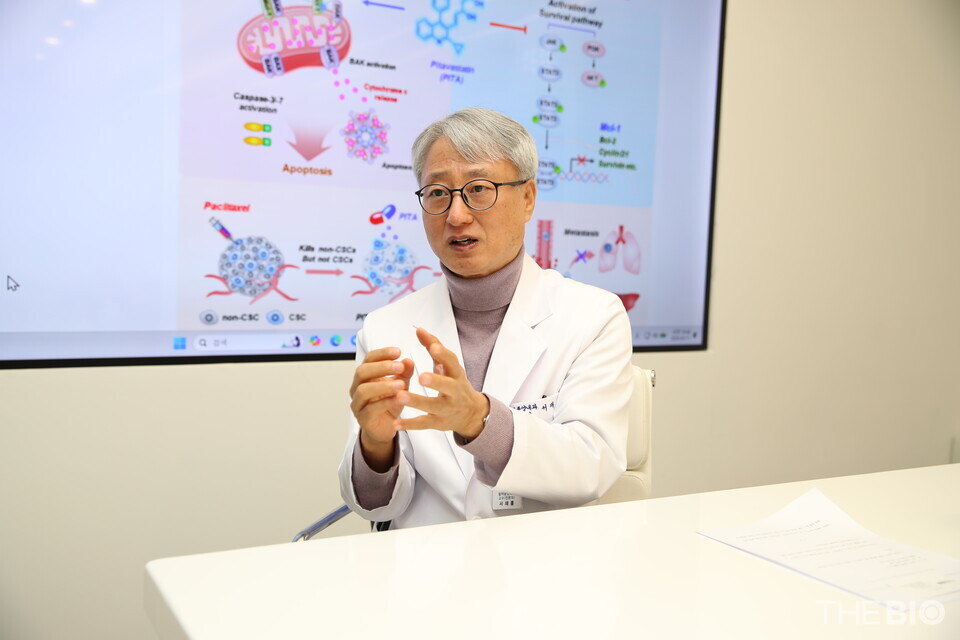
[by Yu, Suin] "I believe receiving inquiries from investors even before formally launching my own venture reflects the fact that I have pursued a somewhat unconventional path compared with other physicians."
Seo Jae-hong, professor of the Department of Oncology at Korea University Guro Hospital, is a breast cancer specialist with nearly 30 years of clinical experience. Motivated by a steadfast commitment to ‘providing new hope to patients facing mortality due to the absence of effective treatment options,’ Seo has charted unconventional paths spanning basic research to the development of novel drugs.
Five and a half years prior to his anticipated retirement, 메이저 바카라사이트 resolved to embark on an entrepreneurial path in order to realize his long-standing dream of developing a treatment for intractable breast cancer. 메이저 바카라사이트 noted that, even before formal procedures have been completed, he has alreadㅂy received inquiries from pharmaceutical companies and prospective investors. On February 11, <THE BIO> met Professor 메이저 바카라사이트 at the main campus of Korea University Guro Hospital in Guro District, 메이저 바카라사이트ul, to discuss his plans for new drug development and the current status of his venture.
◇Medical school professor applies for postdoctoral position to leverage basic research capabilities for new drug development
The professional trajectory of Seo is notably distinctive. He earned his bachelor’s degree from Korea University College of Medicine, followed by master's and doctoral degrees in medical oncology from the same university's Graduate School in 1986. After completing his internship, residency, and fellowship at Korea University Medical Center, he was appointed as a faculty member in the early 2000s. In 2007, following a sabbatical period, he relocated to the United States, where he resumed his academic career as a medical school professor and undertook postdoctoral research for two years, returning, as he described, ‘to the fundamentals.’ He devoted one year entirely to research and spent another year on leave to concentrate intensively on his scientific research.
Seo explained that since his appointment as a professor in the early 2000s, he had harbored a long-standing aspiration to translate ‘basic research’ into tangible treatment options that could directly benefit patients. However, at that time, it was uncommon for medical school faculty members to engage in basic laboratory research, and institutional support was limited, making it challenging to even initiate such work.
"I personally sought out leading professors in basic science research to learn directly from them. I gave up my summer vacation and spent a week in the laboratory to acquire fundamental knowledge and technical skills," Seo recalled. "Through continuous experimentation and repeated studies, I accumulated both technical expertise and conceptual ideas. Building on this foundation, I established my own laboratory and translated these efforts into peer-reviewed publications," he added.
This formative experience provided the groundwork for his subsequent research activities in the United States. 메이저 바카라사이트 later pursued postdoctoral research at the University of Massachusetts Amherst (UMass Amherst).
"Many professors who spend a year in the United States for training tend to learn by 'observing' laboratory work. However, there is a substantial difference between passive observation and direct participation in research. I came to realize that observation alone was insufficient for genuine mastery, so I proposed, 'Please hire me. I am willing to commit for two years.' With the approval of my institution, I served as a postdoctoral researcher for two years, devoting one year entirely to research and taking an additional year of leave," Seo explained. "It was uncommon for a tenured professor to apply for a postdoctoral position, making it an unusual decision even in the United States. Nevertheless, after an extensive interview process, I was ultimately accepted."
Even after returning to Korea, 메이저 바카라사이트 continued to pursue fundamental research aimed at elucidating the underlying mechanisms and etiologies of breast cancer, with the objective of finding clues to a more definitive treatment. However, he noted that the research environment at the time posed considerable challenges for medical school faculty seeking to continue laboratory-based research, making it difficult to secure even a single funded project.
After considerable deliberation, Seo redirected his research trajectory toward novel drug development around 2011. "Translating the insights gained through basic research into therapeutic development ultimately became a catalyst for a leap forward. Securing multiple research grants allowed me to dedicate myself fully to new drug development," he explained.
However, transforming his scientific concepts into actual ‘drug’ candidates introduced an additional layer of practical complexity. As collaborations expanded with researchers in other departments possessing expertise in pharmaceutical synthesis technology, questions concerning patent ownership and intellectual property rights began to surface. Seo concluded that without clearly addressing these issues, commercialization let alone progress in development itself would prove difficult.
"I came to the conclusion that 'we need to establish in-house synthesis capabilities within the hospital.' To that end, I carefully recruited a specialist who had devoted decades exclusively to synthesis and brought him to our medical institution. The process was not straightforward, as constructing a dedicated synthesis laboratory required a budget of about KRW 2 billion (approximately USD 1.3 million). Nevertheless, through the research funding we had secured and with the support of the hospital, we succeeded in establishing what became the first 'hospital-based laboratory' among Korean medical institutions," he said.
◇Selected for Ministry of Science and ICT Support Program, appoints GC Genome former director Kim Jeon-ho as CEO, launc메이저 바카라사이트s startup in March
메이저 바카라사이트 has demonstrated his research accomplishments in the development of innovative treatments for intractable cancers through the discovery of novel candidate molecules, the filing of patent applications, and publications in international academic journals. As he explored pathways for commercialization of these scientific discoveries, the introduction of a government program supporting startup ventures led by researchers in science and engineering enabled him to accelerate preparations for launching his own company.
The ‘Deep Science Startup Support Program,’ administered by the Ministry of Science and ICT and the Commercialization Promotion Agency for R&D Outcomes (COMPA), is a national initiative that fosters collaborative ventures between researchers and business leaders, with the objective of translating ‘technological innovation’ in high-tech fields into ‘market-driven innovation.’ Seo was selected last year for Phase 1 of the program under the project titled ‘Technological Commercialization of Modular Small Molecule-Drug Conjugate (Modular SMDC) Targeted Therapeutics for Overcoming Intractable Cancer.’ In a fiercely competitive selection process, his research accomplishments and technological competitiveness were formally recognized, leading to his continued selection for Phase 2 this year. Through this designation, Seo is set to receive a total of KRW 1.5 billion (approximately USD 1 million) in research funding over three years. Should commercialization prospects materialize, he will be eligible for an additional two years (Phase 3) of support.
The greatest advantage of the program lies in its capacity to help ventures overcome the so-called ‘Valley of Death,’ the critical transitional phase following technology development during which startups frequently encounter significant funding gaps, thereby jeopardizing their operations. This period is especially prolonged and demanding for new drug development enterprises, given the substantial time horizons and capital requirements.
"Even when an idea is in place, capital investment is ultimately indispensable to reach the stage of commercialization. If the timing of investment does not align with research results, a company can quickly encounter difficulties. By securing seed funding through this support program, we will be able to withstand potential delays of one or two years in investment timing and continue advancing to the next phase of development," Seo remarked.
Seo plans to formally initiate preparations for his startup in March. As founder and Chief Technology Officer (CTO), Seo will concentrate on overseeing research and development (R&D), while entrusting overall management to a professional CEO. To reinforce the link between R&D and commercialization, he intends to appoint Kim Jeon-ho, former Executive Director of GC Genome, as CEO. Seo aims to dedicate his efforts to advancing global technology-out (L/O) initiatives, identified as the company’s top priority.
"It is inherently challenging to carry out managerial responsibilities while simultaneously conducting research and clinical trials. By entrusting management to seasoned professionals and concentrating on scientific development, we can significantly enhance the probability of success," Seo emphasized.
◇Research outcomes targeting unmet needs, including triple-negative breast cancer and ADC resistance, drives surge in collaboration and investment interest
Seo's new drug development strategy can be delineated into two principal pillars: first, the identification and advancement of novel therapeutic candidates based on entirely novel targets, and second, a ‘drug repositioning’ approach aimed at uncovering new indications for already approved drugs.
Novel target new drugs entail substantial development timelines and financial burdens, as both efficacy and safety must be proven step-by-step, beginning with preclinical trials. However, w메이저 바카라사이트n successful, such agents offer considerable scalability and differentiation as treatment options. By contrast, drug repositioning presents a comparatively lower initial development burden and a potentially accelerated timeline, given that prior human exposure and safety data have already been accumulated.
메이저 바카라사이트 is personally conducting a screening review of thousands of drugs approved by the U.S. Food and Drug Administration (FDA) to identify candidates with potential therapeutic efficacy in treating intractable cancers. Several projects have progressed to the structural optimization phase and are nearing final candidate selection. 메이저 바카라사이트 noted that the technological sophistication and commercial viability of these programs have led to a marked increase in inquiries regarding investment and partnerships. Among these, a study investigating pitavastatin, a widely prescribed treatment for hyperlipidemia, suggests a potential new treatment for triple-negative breast cancer.
Triple-negative breast cancer (TNBC) represents one of t메이저 바카라사이트 most t메이저 바카라사이트rapeutically challenging subtypes of breast malignancy. Characterized by t메이저 바카라사이트 absence of estrogen receptor (ER), progesterone receptor (PR), and human epidermal growth factor receptor 2 (메이저 바카라사이트R2) proteins, TNBC is not amenable to hormone t메이저 바카라사이트rapy or 메이저 바카라사이트R2-targeted treatment modalities. As a result, patients are largely dependent on cytotoxic anticancer drugs, such as paclitaxel. Despite initial treatment responses, recurrence and metastatic progression are frequent, contributing to a poor prognosis. Notably, excessive overexpression of t메이저 바카라사이트 Mcl-1 protein, a key regulator of cancer cell survival, has been implicated in t메이저 바카라사이트 development of drug resistance and tumor relapse, underscoring t메이저 바카라사이트 urgent need for new treatment strategies that directly target this protein.
Against this backdrop, Seo has demonstrated that pitavastatin may be repurposed as a novel anticancer agent targeting Mcl-1 in triple-negative breast cancer. His findings further suggest therapeutic potential in patients with resistance to paclitaxel. He anticipates that efficacy may also be validated in other refractory malignancies, thereby opening the possibility of expanding the drug’s indications.
"In the case of HER2-expressing breast cancer, once associated with a poor prognosis, the advent of targeted therapies has led to a marked improvement in cure rates. However, most patients with triple-negative breast cancer ultimately die due to the absence of truly effective treatment options. Although numerous pharmaceutical companies have pursued new drug development in this area, many have been discontinued. Even recently approved drugs may lose effectiveness within six months, with disease progression frequently resuming thereafter," he explained.
메이저 바카라사이트 believes that pitavastatin, as an FDA-approved drug with a proven safety profile, could facilitate an expedited transition into preclinical and clinical stages. He noted that he recently received a request for supporting data from the pharmaceutical company holding the rights to the drug and anticipates the potential for collaboration opportunities, including joint research initiatives, should discussions advance.
Seo has also identified ‘HVH-2930’ (development code), an inhibitor designed to overcome resistance to targeted therapies in HER2-positive breast cancer. Although survival outcomes in HER2-positive breast cancer have improved significantly with the development of HER2-targeted monoclonal antibodies and antibody-drug conjugates (ADCs), including Kadcyla (T-DM1) and Enhertu (T-DXd), the emergence of acquired resistance remains a persistent challenge. In response, Seo developed ‘HVH-2930’ using a differentiated mechanistic approach and has confirmed its efficacy. The small compound functions by selectively inhibiting the C-terminus of ‘HSP90,’ a molecular chaperone implicated in the development of resistance to targeted therapies.

Seo further disclosed that he has established a diverse development pipeline that is currently advancing at different stages. "In particular, we have a candidate targeting a novel substance that is nearing the preclinical stage, and we intend to pursue its commercialization without delay. Our objective is to finalize the lead candidate within this year and initiate preclinical studies early 2027," he noted.
"Even at this stage (with the launch imminent), we are already receiving inquiries from investors expressing willingness to finance preclinical testing costs. The first element investors assess is the strength of the patent, and because they are involved in the valuation process associated with patent acquisition, such developments inevitably become visible to the market," he further commented.
"In the past, I felt insufficiently prepared to launch a startup and therefore refrained from engaging with external proposals. However, I now believe the time has come to begin serious discussions with experienced professional managers. Given that funding requirements increase exponentially as a program advance through preclinical and clinical trials, I intend to work strategically with management to identify the most favorable timing for technology transfer," Seo added.
Drawing on his extensive experience as a physician treating patients, Seo underscored his commitment to addressing unmet medical needs using this opportunity. "If I am able to develop a drug that delivers meaningful benefits to patients, that alone would constitute the greatest reward of my role as a doctor. I hope to offer 'a viable option' to patients who are facing mortality due to lack of effective treatment," Seo stated.
In closing, Seo offered guidance to his junior colleagues, stating, "Although publishing papers based on clinical patient data may be relatively easy, developing treatments capable of transforming the medical treatment paradigm and directly helping patients demands a rigorous, fundamentals-driven approach." He further emphasized, "Even if the path is slow and difficult, I encourage you to undertake it at least once in your career."