

- President Kim Yeol-hong outlines business direction at R&D DAY
- Assessing modalities best suited for cancer and metabolic diseases, while recognizing limitations of ADCs
- Planning organizational restructuring for R&D success, including consideration of a new company (newco) establishment
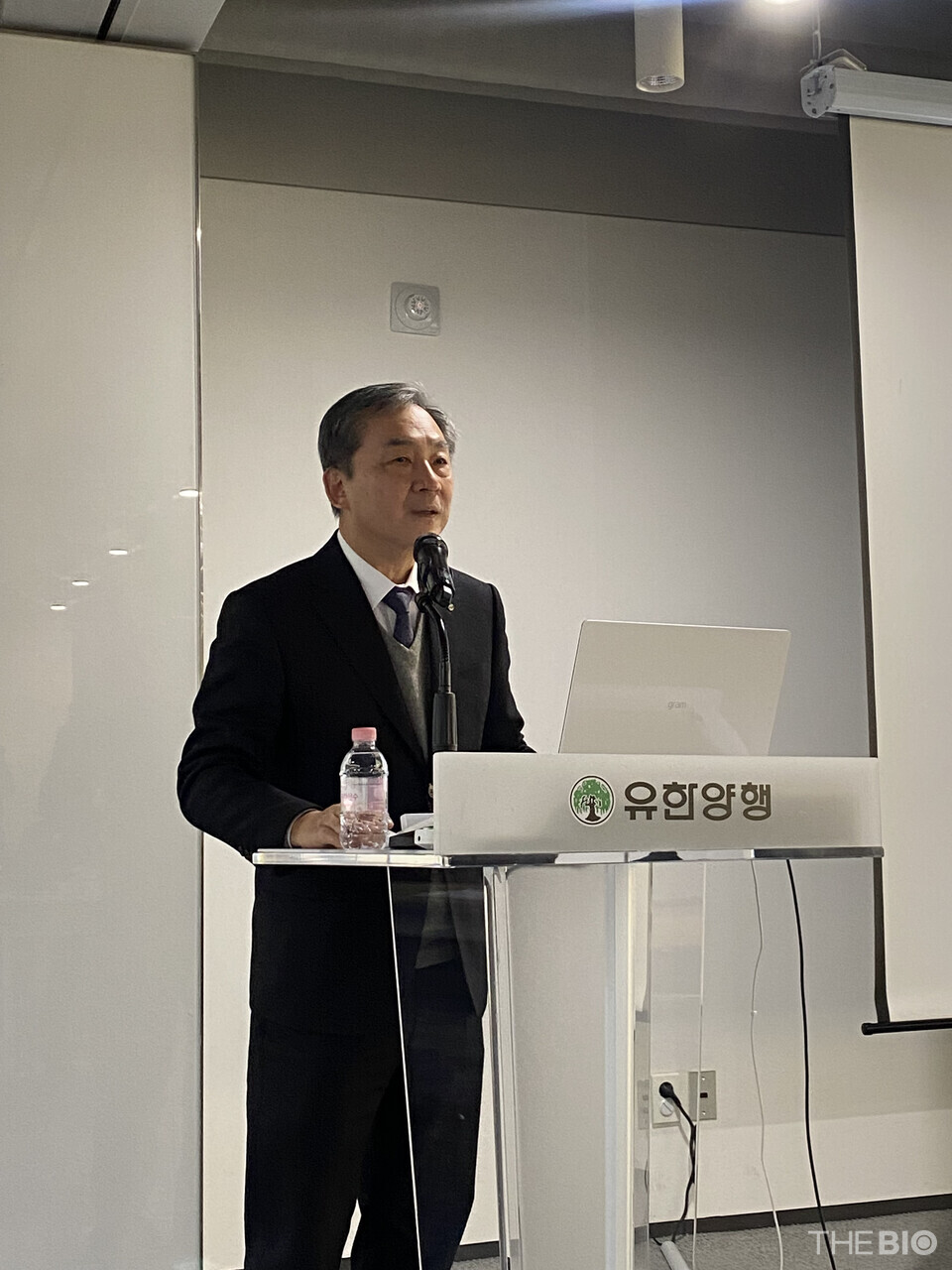
[by Yu, Suin] "We have determined that 'Targeted Protein Degradation (TPD)' represents a therapeutic modality that aligns with the disease areas in which Yuhan Corporation excels."
Kim Yeol-hong, president of R&D at Yuhan Corporation, made these remarks during the company’s ‘R&D DAY’ event held on the afternoon of January 21 at its headquarters in Dongjak District, Seoul. At the event, Kim outlined the rationale for selecting TPD as a next-generation growth engine. The briefing was organized to present Yuhan Corporation’s current R&D progress and key pipeline assets to pharmaceutical and biotechnology analysts, as well as institutional investors.
First, Kim recalled that following his appointment as president in 2023, a comprehensive review of the company’s pipeline revealed what he characterized as a ‘lack of focus.’ After a series of internal discussions, he refined the company’s R&D priorities to concentrate on ‘oncology, metabolic disorders, immune-mediated diseases, and inflammatory conditions,’ while pursuing ‘new therapeutic modalities.’
Kim explained that oncology R&D spans a wide spectrum, covering both hematologic malignancies and solid tumors, as well as a diverse range of therapeutic approaches, from cytotoxic anticancer drugs to targeted therapies and immuno-oncology modalities. He noted that 우리카지노 바카라사이트 Corporation has continued to advance its R&D activities by clearly defining and aligning roles with its affiliates and external partners.
In the area of metabolic diseases, the company has prioritized the ‘metabolism, cardiovascular, and renal (CVRM)’ field, encompassing obesity, diabetes, cardiovascular disorders, renal diseases, and liver conditions. Given that these disease areas have a direct impact on human survival and longevity, they are characterized by substantial unmet medical needs and strong potential for the creation of new markets. Kim further noted that Yuhan Corporation has decided to further expand its development scope in immune and inflammatory diseases, building on the company’s accumulated research experience and expertise.
Conversely, Kim acknowledged that there were considerable internal concerns regarding the selection of new modalities. "After carefully assessing 'which modalities would best fit with the oncology and metabolic disease areas in which Yuhan Corporation has established capabilities and excels,' we concluded that TPD was the most appropriate choice. At the time, antibody-drug conjugates (ADCs) were rapidly gaining attention. However, given Yuhan Corporation’s limited experience in biopharmaceuticals and our assessment of the inherent limitations of ADCs, we ultimately decided to pursue TPD," he explained.
"ADCs are intrinsically confined to oncology indications, and it is challenging to achieve outcomes proportionate to the significant time, cost, and resources required to address issues like drug resistance and quality control. As with other innovative new drug modalities, where only two out of 100 candidates ultimately succeed, the success rate for ADC drug development is likewise extremely low, a mere 2%," he further stated.
Kim emphasized that TPDs offer significant scalability beyond oncology, extending into ot우리카지노 바카라사이트r disease areas such as immune disorders, while enabling t우리카지노 바카라사이트 use of diverse payloads, including c우리카지노 바카라사이트mically synt우리카지노 바카라사이트sized small molecules. 우리카지노 바카라사이트 furt우리카지노 바카라사이트r emphasized its decision to prioritize TPDs based on t우리카지노 바카라사이트ir relatively small molecular size, which offers advantages in manufacturing efficiency and cost competitiveness, as well as t우리카지노 바카라사이트ir potential to address targets that are difficult to modulate effectively with conventional single-agent t우리카지노 바카라사이트rapies.
As part of this effort, Yuhan Corporation has established a dedicated new research organization focused on TPD. Earlier this month, the company launched the ‘New Modality’ division within its Central Research Institute and appointed Executive Vice President Cho Hak-ryul to lead the unit. The newly formed division is tasked with advancing R&D for novel modalities, with a primary emphasis on TPD-based technologies.
Unlike conventional small-molecule drugs or antibody-based therapies, TPD is a next-generation platform that selectively eliminates disease-causing ‘target proteins,’ extending the therapeutic reach to the so-called ‘undruggable targets’ that have been difficult to address with existing modalities. Reflecting this potential, major global pharmaceutical companies such as Amgen, Pfizer, and Merck are actively expanding their pipelines through joint research with biotechnology firms specializing in TPD technologies or through the acquisition of such technologies.
Meanwhile, Kim emphasized that Yuhan Corporation is seeking to enhance its R&D success rate by improving efficiency and development speed. "While Yuhan Corporation benefits from a long corporate history, there have been observations that limited flexibility and a relatively rigid organizational culture could pose challenges to R&D," he said. "Concerns have also been raised that an increasing proportion of long-tenured employees may constrain R&D innovation, owing to insufficient recruitment of external talent, resistance to change, and an organizational emphasis on stability. Some have also cautioned that we may be growing complacent following the success of Leclaza," he added.
"We are also aware of concerns that, as China rapidly closes the gap through speed and technical expertise, survival will be difficult without the capacity to develop novel drugs based on our own proprietary platform. In response to these challenges, Yuhan Corporation has been undertaking strategic restructuring over the past one to two years with the objective of enhancing efficiency and speed," Kim explained.
"First, we are implementing tailored business development (BD) activities by assigning specialized project managers (PMs) to each pipeline. We are also advancing BD initiatives through our U.S. base to broaden our network with specialized companies in the United States and Europe. We are also actively considering the establishment of 'Newco' (new company) as part of these efforts," he further commented.
Finally, Kim emphasized that Yuhan Corporation is introducing incentive-based mechanisms to stimulate internal change while simultaneously expanding its research workforce and strengthening external collaborations. "We are also considering establishing a dedicated unit within the R&D organization that would function as a 'special force' to drive new development initiatives," he said.